The electronics industry is rapidly evolving toward higher density and miniaturization.
As the core structural component of various electronic devices, printed circuit boards (PCBs) are increasingly adopting multilayer designs, leading to ever-stricter requirements for forming precision.
As the core equipment in the lamination and forming process of printed circuit boards, the mechanical structural stability, transmission precision, and process adaptability of laminators directly determine the interlayer bonding quality, dimensional consistency, and overall performance of PCBs.
Current Industry Limitations and Process Challenges
However, most laminators in the industry currently rely on manual labor to complete core operational processes, which can easily lead to process deviations due to variations in human operation, resulting in insufficient process stability.
Therefore, upgrading laminators with automation technology has become an urgent need in the industry’s development.
In existing research, while many high-end laminators enhance performance through complex mechanical structures, core structural patents remain locked, and the high cost of such equipment makes it difficult to adopt among small and medium-sized enterprises.
Gaps in Existing Mechanical Design Approaches
Most existing studies focus on improving individual mechanical components (such as optimizing the material of the pressure plates) without establishing a systematic mechanical structure optimization framework.
They overlook the coordinated design of positioning, pressing, and locking modules, resulting in persistent issues such as positioning that relies on manual calibration, poor pressing synchronization, and severe wear in the locking mechanisms.
Proposed Multi-Module Collaborative Optimization Scheme
To overcome these bottlenecks, this study proposes a multi-module collaborative mechanical structure optimization scheme.
The study innovatively designs a feed self-alignment module that features V-groove guidance and spring-loaded clamping to achieve precise positioning without manual intervention.
A multi-cylinder synchronous pressing module is constructed by combining mechanical synchronous shafts with honeycomb pressing plates to address uneven pressure distribution.
It develops a cam-linked self-locking engagement module to enhance engagement efficiency and reliability.
It also integrates mechanical auxiliary monitoring components to ensure the stable operation of core mechanical modules, thereby establishing a comprehensive mechanical optimization system for the laminating machine.
Design of the Core Mechanical Modules for Laminating Machines
Current PCB laminating machines largely rely on manual labor for feeding and positioning, pressure synchronization control, and clamping operations.
This results in significant positioning and pressure distribution deviations, as well as time-consuming clamping processes, severely limiting production accuracy and efficiency.
Furthermore, manual operation is prone to errors and component wear.
To enhance the precision and stability of mechanical movements, this study explores innovations in purely mechanical structures and designs three core mechanical modules.
These innovations aim to overcome the existing bottlenecks in equipment accuracy and efficiency at the mechanical level.
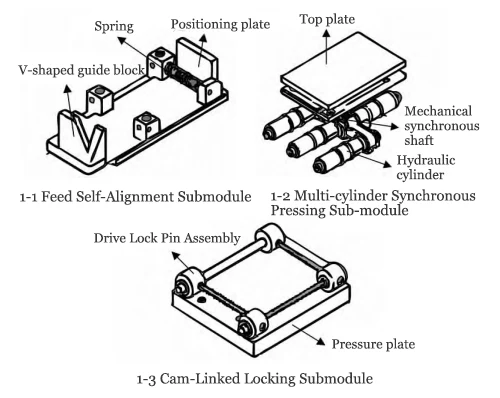
The overall structure is shown in Figure 1.
Modular Integration and System Design Concept
As shown in Figure 1, the module adopts an overall design concept of “modular integration + purely mechanical linkage” and consists of three core submodules:
Feed Self-Alignment Submodule
The first is the feed self-alignment submodule, which features 60° V-shaped guide blocks (surface-hardened, surface roughness Ra=0.8) arranged on the feed table, with a spring-loaded positioning stopper at the front end (equipped with miniature roller bearings, model 623ZZ, with a friction coefficient ≤0.02).
During operation, the PCB moves with the feed table; automatic X-axis centering is achieved through the inclined surfaces of the V-shaped guide blocks, while the spring-loaded positioning stop uses elastic force (spring stiffness coefficient 8 N/mm, compression stroke 5 mm) to press the PCB firmly into place, completing Y-axis positioning.
The entire process requires no manual intervention.
Multi-Cylinder Synchronous Pressing Submodule
The second is a multi-cylinder synchronous pressing sub-module, driven by four hydraulic cylinders.
The core innovation lies in the addition of a mechanical synchronizing shaft made of 40Cr steel, with a diameter of 30 mm and a chrome-plated surface (plating thickness: 0.05 mm).
This shaft is rigidly connected to the piston rods of the hydraulic cylinders via a coupling, thereby forcibly constraining the displacement deviation of the four piston rods (synchronization accuracy ≤ 0.03 mm).
Additionally, the upper pressure plate adopts a honeycomb rib structure, with a 25 mm thick Q235 steel plate as the base and 50 mm high 6061 aluminum alloy ribs spaced 50 mm apart.
Compared to traditional solid pressure plates, this design reduces weight by 30% and improves pressure transmission uniformity by 45%.
Cam-Linked Self-Locking Submodule
Third is the cam-linked locking submodule. Cam-driven locking pin assemblies are installed at the four corners of the frame.
The cams are made of GCr15 steel with a surface hardness (HRC) of 60–62.
The locking pin has a diameter of 20 mm and is made of 45 steel.
The cam profile includes a lift section and a self-locking section; the cam rotates as the lower pressure plate moves up and down, triggering the locking pin to automatically insert into or withdraw from the locking hole, thereby achieving purely mechanical self-locking and unlocking.
Optimization of Mechanically Assisted Monitoring and Protective Structures
The structural design of the laminator’s core mechanical modules enhances the precision and stability of mechanical operations.
To ensure the stable operation of these core modules and prevent production failures caused by mechanical abnormalities, mechanical condition monitoring sensors have been deployed on the core mechanical modules to provide real-time status feedback.
Feed Self-Alignment Monitoring System
Regarding the feed self-alignment submodule, diffuse-reflection photoelectric sensors (Model E3Z-LS63, detection range 50 mm) were installed on the inner side of the V-shaped guide block to detect whether the PCB is properly aligned, thereby preventing mechanical shocks caused by air pressure.
Multi-Cylinder Pressing Pressure Monitoring
For the multi-cylinder synchronous pressing submodule, pressure sensors (Model PT124G-111, measurement range 0–20 MPa, accuracy ±0.5% FS) were installed at the base of each of the four hydraulic cylinders to monitor individual cylinder pressure deviations in real time.
The formula for calculating pressure deviation is defined as shown in Equation (1).
δp=(| p i-p 0)/p 0|×100%.(1)
Where: δp is the pressure deviation of a single hydraulic cylinder;
pi is the real-time measured pressure value of the i-th hydraulic cylinder (i = 1, 2, 3, 4, corresponding to the four synchronized hydraulic cylinders), in MPa;
p₀ is the standard pressure value set for the pressing process, in MPa.
When δp > 10%, the electrical system triggers an alarm, indicating that the mechanical synchronous shaft may be jammed or misaligned, requiring manual inspection.
Cam-Linkage Locking Verification System
Regarding the cam linkage locking submodule, a proximity switch (model TL-N10ME1, detection distance 10 mm) was installed at the end of the locking pin to verify that the insertion depth meets the requirement (≥10 mm), thereby preventing equipment damage caused by pressurization before proper locking.
All sensors feature oil-resistant encapsulation (IP67 protection rating), making them suitable for the high-temperature (≤180 °C) and oily environment of the laminating machine to ensure monitoring reliability.
Mechanical Protection and Lubrication System Design
To extend the equipment’s service life, additional mechanical protection and lubrication structures were designed.
Install retractable dust covers on the outer sides of the feed table guide rails.
These rails have a stroke of 500 mm; the dust covers are made of nylon fabric with a thickness of 0.5 mm to prevent dust from entering the rails and reduce wear;
A mechanical timed lubrication pump is used to deliver oil at set intervals.
This pump has a capacity of 400 mL and utilizes a gear train with a module of 1.5 and 20 teeth to perform the oil supply action.
The lubrication cycle is set to 9.4 hours. A lubricant level sight glass is also provided; the sight glass is made of tempered glass and measures 50 mm × 30 mm, facilitating manual observation of the oil level;
Emergency Stop Safety Mechanism
A mechanical emergency stop mechanism is installed next to the pressing module.
This mechanism consists of a spring-loaded locking pin with a diameter of 8 mm and a stroke of 10 mm.
A mechanical abnormality is detected. The locking pin is manually triggered.
The locking pin engages with the slot on the synchronous shaft. The system forcibly stops the pressing operation. Operational safety is enhanced.
Analysis of the Optimization Plan’s Effectiveness
The study verifies the effectiveness of the optimization plan. One LY-600 laminating machine is selected from a PCB manufacturer. The machine has been in use for three years.
The machine has a single-shift production capacity of 500 boards. The yield rate stands at 85% before optimization. The study performs retrofitting on the selected machine.
The study conducts a one-month production validation after the retrofit. The validation includes multiple test metrics.
Positioning accuracy is evaluated. Pressure distribution is evaluated. Production efficiency is evaluated. Equipment reliability is evaluated.
Experimental Setup and Measurement Method
The study used a coordinate measuring machine (CMM) to test the feed positioning accuracy of the modified laminator.
A random sample of 100 PCB boards (dimensions: 300 mm × 200 mm, 8-layer boards) was selected to measure positioning deviations in the X and Y directions.
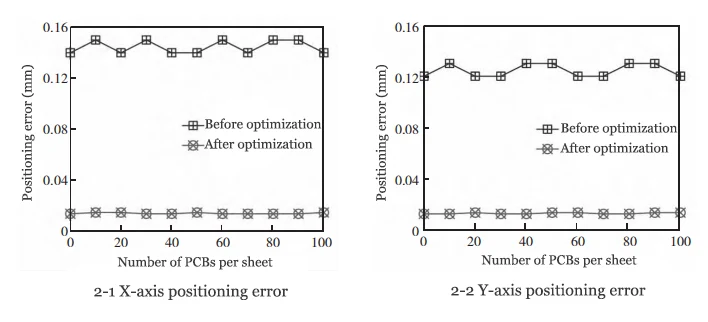
The results are shown in Figure 2.
Positioning Accuracy Improvement Results
Figure 2-1 shows the results. Prior to optimization, X-axis positioning deviation fluctuates between 0.12 and 0.16 mm. The system exhibits high variability.
After optimization, X-axis positioning deviation stabilizes within 0.02 mm. The result represents a significant improvement in accuracy.
As shown in Figure 2-2, prior to optimization, the Y-axis deviation fluctuated between 0.12 and 0.14 mm; after optimization, it stabilized within 0.02 mm.
After optimization, X-axis positioning deviation is significantly reduced and stabilized.
Y-axis positioning deviation is significantly reduced and stabilized. The modifications effectively improve feed positioning accuracy.
The optimized positioning accuracy fully meets the lamination process requirement of ≤0.05 mm for multilayer PCBs.
Multi-Dimensional Performance Evaluation
Production Efficiency and System Performance Validation
Regarding production efficiency and energy consumption, single-shift output increases by 64.5%. Overall equipment effectiveness (OEE) exceeds 92%.
The system achieves the dual goals of cost reduction and efficiency improvement.
These results fully validate the feasibility and superiority of the multi-module collaborative mechanical optimization scheme.
The scheme effectively enhances the performance of the laminator. Mechanical structural innovation drives this improvement.
| Test Indicator | Before Optimization | After Optimization |
|---|---|---|
| Lamination Pressure Distribution Deviation (%) | ±18.2 | ±4.3 |
| Maximum Pressure Fluctuation per Cylinder (MPa) | 0.8 | 0.15 |
| Locking Mechanism Response Time (s) | 15.6 | 1.8 |
| Locking Failure Rate (%) | 2.50 | 0 |
| Equipment Failure Frequency per Shift (times) | 2.3 | 0.2 |
| Sensor False Alarm Rate (%) | 1.80 | 0.10 |
| Output per Shift (pieces) | 502 | 826 |
| Cycle Time per Piece (s) | 57.3 | 36.1 |
| Overall Equipment Efficiency (%) | 64.80 | 92.30 |
| Monthly Wear of Guide Shaft (mm) | 0.21 | 0.048 |
| Lubrication System Maintenance Interval (h) | 36 | 9.4 |
| Electrical System Energy Consumption (Auxiliary) (kW·h/shift) | 12.8 | 10.3 |
Table 1: Multi-Dimensional Data Comparison of Mechanical Structure Optimization for Laminating Press
Conclusion
Mechanical structural innovations drive this study. The study designs three core mechanical modules and supporting auxiliary structures.
The design achieves a comprehensive improvement in equipment performance.
The designed feed self-alignment submodule utilizes V-groove guidance and spring-loaded mechanical constraints.
The system stabilizes X/Y-axis positioning deviations within 0.02 mm. The reduction compared to pre-optimization values (0.12–0.16 mm) is significant.
The multi-cylinder synchronous pressing submodule utilizes a mechanical synchronous shaft and honeycomb pressure plates.
Pressing pressure distribution deviation is reduced from ±18.2% to ±4.3%. Pressure transmission uniformity is improved.
The cam-linked locking submodule, through a self-locking design in the cam profile, shortened the locking response time from 15.6 s to 1.8 s and reduced the failure rate to 0%.
The accompanying mechanical monitoring and protection structures further ensure stable equipment operation. Single-shift production capacity increases from 502 to 826 boards.
Overall equipment effectiveness (OEE) reaches 92.30%. The OEE is compared to 64.80% before optimization.
Evidently, this optimization scheme enhances the overall performance of the PCB laminator.
However, the study has not yet designed an adaptive mechanical adjustment structure tailored to the lamination requirements of PCBs of varying thicknesses.
A life prediction model for the mechanical module’s critical components has not been established.
Early warnings of component failure risks cannot be provided.
Future research will focus on developing a thickness-adaptive pressing structure based on a combination of mechanical cams and springs.
Concurrently, mechanical vibration monitoring components are integrated to collect vibration signals.
A vibration-based life prediction model is constructed. Intelligent prediction of the health status of mechanical components is enabled.
Equipment adaptability and reliability are further enhanced.